The Problem
I have been thinking a lot about reading lately.
Partly because I have two reading-age kids.
Partly because I am writing a middle-grade novel.
And partly because I am re-reading the books I loved as a kid.

Some of my all-time faves
As a kid, these books helped me dream of a world bigger than the one I was in.
And now I’m watching my kids grow up in a world with the entirety of the world wide web competing for their attention.
And unfortunately books seem to be losing.
Only 31% of fourth graders met the national reading proficiency benchmark.
That's a serious problem. And one worth considering.
But what if we also focused not just on whether kids can read, but whether they want to?
Scholastic tracks kids’ reading habits, and the drop-off starts surprisingly young.
46% of 6–8-year-olds are frequent readers. By ages 9–11, it’s just 32%.
Which happens to be the age of my oldest daughter. Cool cool cool.
While we process that, let’s hear from an adult who might have figured some things out.

I’m dying thinking about them gossiping about Dog Man.
What Parents Told Me
So, I did what people who write a newsletter about parent problems would do: I surveyed parents.
What struck me most about their answers was that parents aren't sitting around saying, Meh, reading. Who cares? They're trying. Like really hard.
They're going to the library. Leaving books around the house. Reading at bedtime. Asking teachers. Asking librarians. Asking other parents. Buying loads of books.
One parent told me:
“Why does he not want to read all the books that I bought him?”
Another described the challenge as simply:
“Finding books/series that are the right level and that they are interested in.”
And another has a daughter who actively dislikes reading and said she hasn't found a book that makes it enjoyable.
Another parent said if the story doesn't hook her kids in the first chapter, they're out.
This isn’t a problem of parents not caring about reading.
Reframe
We talk constantly about getting kids to read.
Reading logs. Twenty minutes a night. Summer reading challenges. Complex star charts that have a reward but is kind of just bribery.
But what if we spent more time helping them find books they actually want to read?
When I asked parents what had helped their kids read more, the answer felt nearly universal:
70% of parents said, “finding a series they got hooked on.”
50% said letting their kids choose their own books helped. And just under half said graphic novels or audiobooks has encouraged their kids to read more.
It's a small survey, but larger research points in the same direction.
Scholastic found that kids who enjoy reading are much more likely to read frequently.
Which seems embarrassingly obvious when you say it out loud.
Kids read when reading is something they like doing.
And yet we spend so much time worrying about how much they're reading, what level they're reading at, or whether they're progressing beyond graphic novels.
Maybe it’s more about:
The right kid. The right book. At the right moment.
Because sometimes all it takes is one book to turn a kid who doesn't like reading into a kid who can't stop.
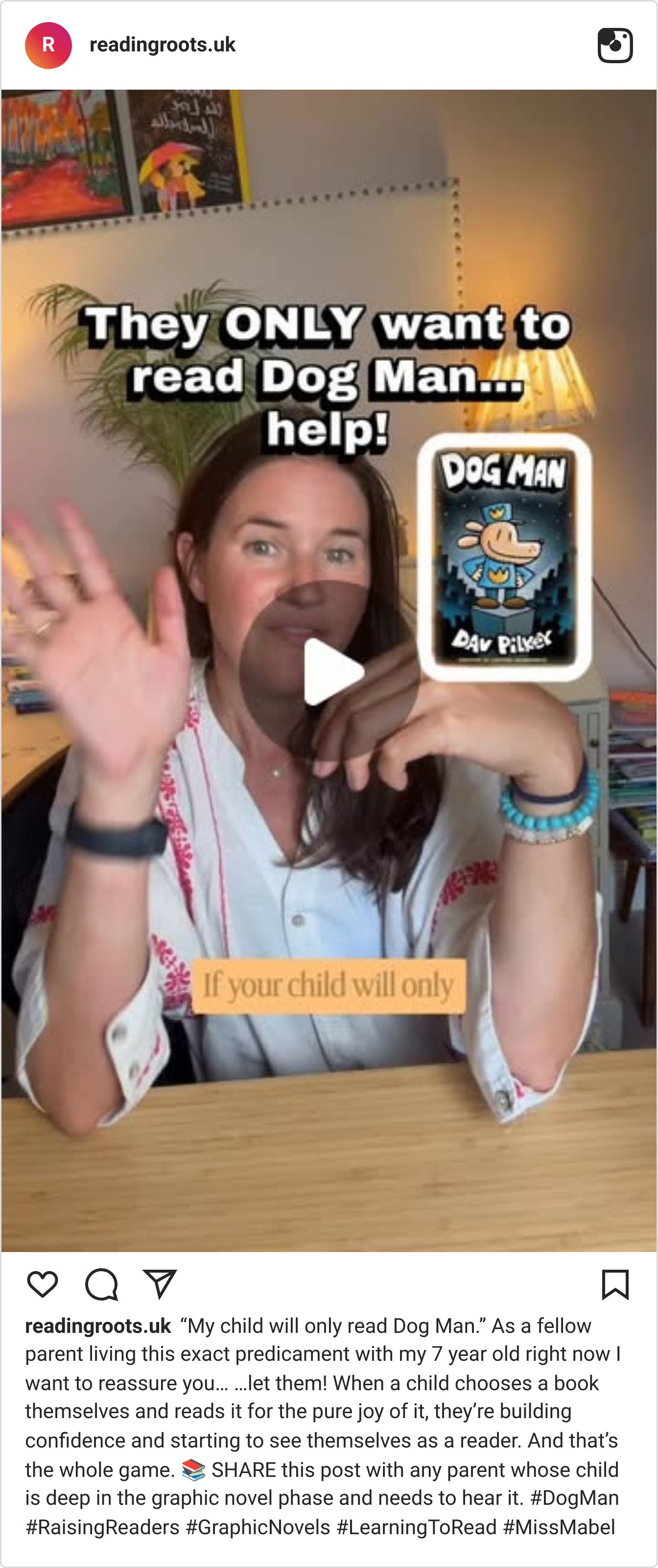
If you want the TL;DR of this whole newsletter listen to this soothing British reading expert and definitely give her a follow
But Why Should We Care So Much?
Because obviously we want my kids to be good readers. It is the foundation of most forms of learning.
But learning isn’t the only thing books are good for.
When I think about the books that mattered to me as a kid, I don't remember if I was reading at grade level or not.
I remember the feeling those books gave me. Hope. Despair. Love. Joy. I lived hundreds of lives. And got lost in worlds that was nothing like my own.
Books captivated me. And nothing could interrupt me.
And it’s a painful realization that books might be the last place where beauty exists without advertising or something trying to steal your attention.
Think about it. There are no ads in the middle of Charlotte’s Web. Just a beautiful drawing that imprints on your mind.

Nobody interrupts Narnia to show you a violent preview of a new video game.
In a world where everyone seems to be competing for our kids' attention, I want them to have somewhere that rewards it with beauty and meaning.
So What Do We Do?
I don't think the answer is to become the Book Police. Or to create a new reading challenge. Or to stress about getting kids to go from graphic novels to chapter books.
Our survey actually made me think the opposite. We need to get much better at helping them find the books they will like to read. Regardless of what we think they should be reading. More time talking to librarians or perusing bookshops.
Because reading for pleasure requires only one ingredient: Pleasure.
And if we help them find the pleasure in reading, they might become adults like Ashley: FERAL.

So I’m Building Something
I’m going to spend more time on this question: what makes kids passionate readers? And how do you find the right book at the right time that they will actually enjoy.
I’ve met with twenty parents, interviewed a children’s book seller, and have a coffee date with a librarian on Friday. All to understand, what ingredients go into the right recommendation at the right time for a child?
Along the way I'm building a giant database of book recommendations.
Not just:
AGE 9 → FANTASY → HERE ARE 487 BOOKS.
Instead, recommendations that help parents answer:
What will my my kid love to read next?
And I'm calling this Tender Hearts Reading Club.
Parent Problems isn't going away. I'm still a parent. There are still loads of problems.
But I'm convinced that helping our kids become people who love to read —and helping adults remember why we loved it in the first place—is a problem worth solving.
In the meantime, I’d love your help building the database. If you have 2 minutes to tell me about a book your child loved, please click the link below!
With you,
Rachael